
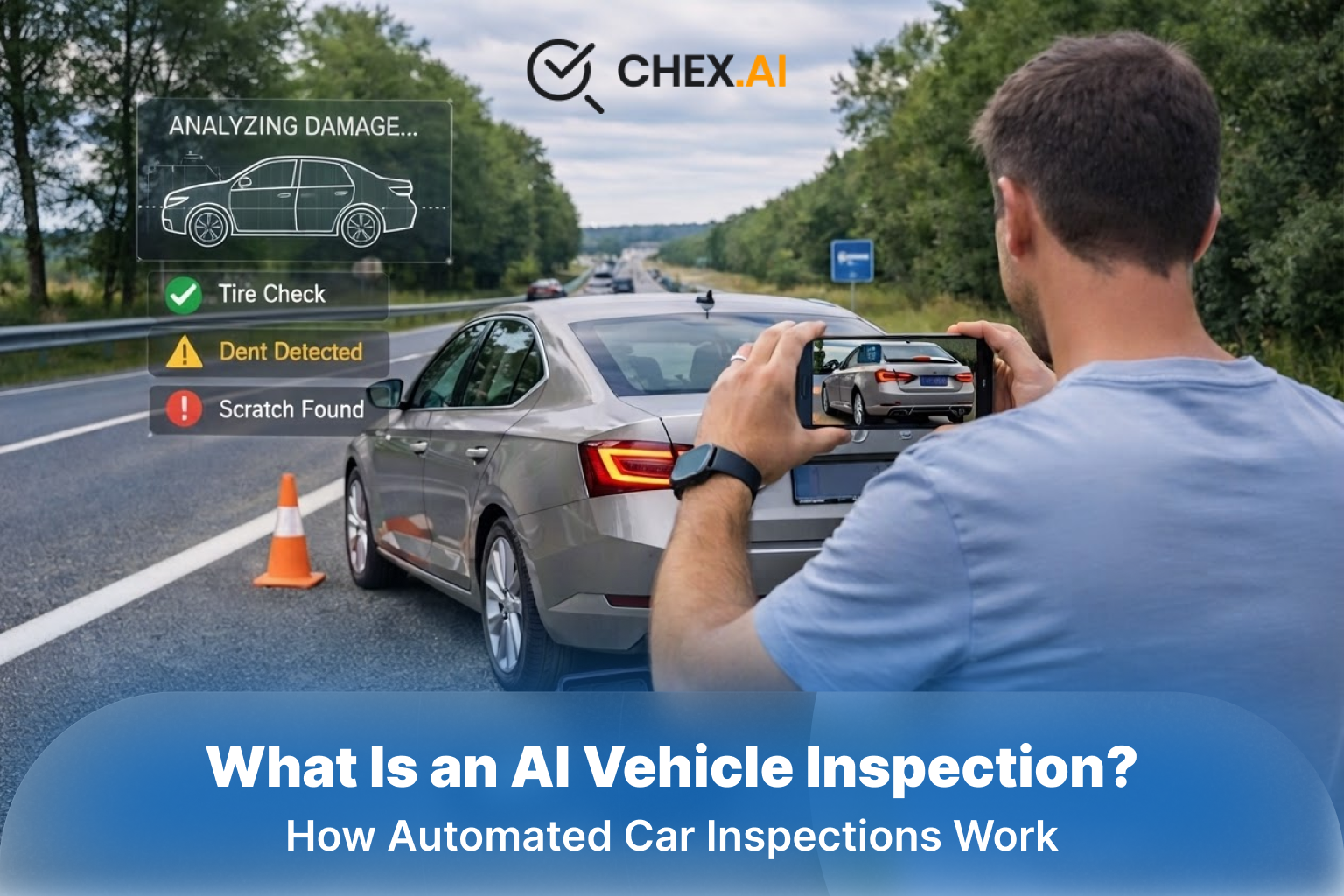
An AI vehicle inspection is a vehicle condition check performed by artificial intelligence instead of a human inspector. The driver captures guided photos or video of the vehicle on a smartphone, and computer-vision models detect damage, read the VIN and odometer, and generate a standardized inspection report typically in minutes, without a garage appointment.
Traditional inspections require booking a shop, driving there, and waiting while a mechanic completes a manual walkaround. An automated car inspection removes all three steps. The vehicle stays where it is, and the analysis happens on the images.
How automated car inspections work
Every AI inspection follows the same five stages, whether it's a rideshare driver certifying their car or an insurer documenting a claim.
- Guided capture. The app prompts the user through a 360° sequence front, sides, rear, wheels, interior, dashboard. On-screen example photos show exactly what each frame should contain, which is what keeps quality consistent across untrained users.
- Image quality validation. Before analysis begins, the system checks each frame for blur, poor lighting, or incomplete coverage and asks the user to retake anything unusable. Bad inputs are rejected at capture, not discovered later.
- Damage detection. Computer-vision models compare each panel against learned patterns of undamaged vehicles. Chex.AI detects damage across 163 vehicle parts with 95–99% accuracy and classifies 21 distinct damage types dents, scratches, cracks, missing components, and more.
- Data extraction. Optical character recognition reads the VIN, license plate, and odometer directly from the images, so no one types them in and no one transposes a digit.
- Report generation. The system compiles findings into a standardized, timestamped digital report with photographic evidence attached ready for claims, underwriting, compliance, or platform approval.
The whole sequence takes minutes rather than hours. Chex.AI has run this process for more than 50,000 inspections across 10+ countries.
AI vehicle inspection vs. manual inspection
The difference isn't only speed. It's consistency and evidence.
| Factor | AI vehicle inspection | Manual inspection |
|---|---|---|
| Time to complete | Minutes, from a phone | Hours, including travel and waiting |
| Location | Anywhere | Requires a shop or inspection site |
| Consistency | Same standard applied to every vehicle | Varies by inspector and by day |
| Evidence | Timestamped photos attached to every finding | Paper form, often without images |
| Data entry | VIN, plate, odometer read automatically | Typed by hand, transposition errors possible |
| Fraud controls | Flags duplicate, stale, or manipulated images | Depends on inspector judgment |
| Availability | 24/7, no appointment | Limited to business hours |
| Cost at scale | Low marginal cost per inspection | Each inspection carries labor cost |
A manual inspection depends on who performs it. Two inspectors can reach different conclusions about the same bumper. An automated system applies one standard to every vehicle, and critically attaches the photographic evidence that supports each finding, which is what makes a report defensible in a dispute.
What can an AI inspection detect?
- Exterior damage — dents, scratches, scuffs, cracks, paint damage, and rust across all 163 mapped vehicle parts
- Missing or broken components — mirrors, lights, trim, bumper sections
- Glass damage — windshield cracks and chips
- Tire and wheel condition — visible wear and rim damage
- Vehicle identity data — VIN, license plate, and odometer reading
- Image integrity issues — duplicated, edited, or previously submitted photos
AI inspections assess what a camera can see. They do not replace a mechanical diagnostic a failing transmission, worn brake pads, or an engine fault requires a physical inspection or an OBD-II scan. Being explicit about that boundary is part of using the technology well.
Who uses AI vehicle inspections?
Rideshare drivers. Drivers complete their Uber or Lyft vehicle inspection from a phone in about 30 minutes and receive same-day certification. Chex.AI inspections are accepted by Uber, Lyft, Turo, and HopSkipDrive in supported states. → Rideshare inspections · Uber inspection · Lyft inspection
Commercial fleets. Fleets run digital Driver Vehicle Inspection Reports (DVIR) with AI damage documentation, replacing paper forms and manual walkarounds while improving DOT compliance. → Fleet & DSP inspections · What is a DVIR?
Insurers. Remote inspections support underwriting, policy verification, and claims standardized evidence collected without dispatching a field adjuster.
Rental companies. A consistent damage check at every pickup and return, with timestamped evidence that resolves renter disputes.
Towing and valet operators. A condition report captured the moment a vehicle enters custody, protecting against false pre-existing damage claims.
How accurate is AI damage detection?
Accuracy depends on image quality, which is why guided capture matters more than the model alone. Chex.AI reports 95–99% accuracy across 163 vehicle parts, supported by three controls:
- Pre-analysis validation rejects blurry or incomplete images before they reach the model
- Guided prompts show users the exact framing required, so coverage is complete
- Fraud detection flags manipulated, duplicated, or stale images before they enter a report
The practical test isn't whether AI matches a perfect inspector it's whether it beats a rushed one. A manual walkaround performed quickly at the end of a shift, with no photos attached, is the realistic alternative in most operations.
How much does an AI vehicle inspection cost?
Chex.AI rideshare inspections start at $29.99, compared with the $50–$150 typically charged for an in-person inspection at a shop, plus the driver's travel and waiting time. Fleet and enterprise pricing is volume-based.
→ Rideshare pricing · Commercial fleet pricing
Across its customer base, Chex.AI reports over $5 million saved in inspection costs.
Are AI vehicle inspections accepted officially?
Acceptance depends on the requiring party, not the technology. Rideshare platforms including Uber, Lyft, Turo, and HopSkipDrive accept Chex.AI inspection certificates in supported states. For fleets, electronic DVIRs with timestamped visual evidence meet eDVIR reporting requirements.
State safety and emissions inspections are a separate matter those are set by state law and generally still require a licensed physical inspection station. Check your state's requirements before assuming an online inspection substitutes for a state safety test.
How to complete an AI vehicle inspection
- Prepare the vehicle. Wash it, park in good light, and clear the interior. Dirt reads as damage; poor light produces retakes.
- Start the inspection. Open the app and select your inspection type.
- Follow the capture prompts. Match each on-screen example. Don't skip frames missing angles are the most common cause of a rejected report.
- Review flagged images. Retake anything the system marks as blurry or incomplete.
- Submit and receive your report. Findings, evidence, and certification are returned the same day for rideshare inspections.
Frequently asked questions
How accurate is AI damage detection?
Chex.AI detects damage across 163 vehicle parts with 95–99% accuracy and identifies 21 damage types. Accuracy depends on image quality, so the system validates every frame and prompts for retakes before analysis.
How long does an AI vehicle inspection take?
Capture takes a few minutes. Rideshare drivers typically complete the full process in about 30 minutes and receive same-day certification.
Is an AI inspection cheaper than a mechanic?
Chex.AI inspections start at $29.99, against $50–$150 for a typical in-person inspection before counting travel and waiting time.
Can AI detect mechanical problems?
No. AI inspections assess visible condition. Mechanical faults require a physical diagnostic or OBD-II scan.
Do Uber and Lyft accept AI inspections?
Yes, in supported states. Chex.AI certificates are accepted by Uber, Lyft, Turo, and HopSkipDrive.
What happens if my photos are rejected?
The app flags the problem frame and prompts a retake before analysis, so incomplete submissions are caught at capture rather than after review.
Ready to inspect your vehicle?
Complete your inspection from your phone in about 30 minutes no appointment, no shop visit, same-day certification. From $29.99.
Running a fleet or handling claims at volume? Request a demo →